
Federal Pacific electrical panels are found in many older homes. The name often raises concern during a home inspection, especially when the panel contains Stab-Lok circuit breakers.
Finding one does not mean the house has an active electrical emergency. It does mean the panel deserves careful attention because questions have been raised about whether certain breakers will trip properly when a circuit is overloaded.
What Is a Federal Pacific Electrical Panel?
Federal Pacific Electric, often abbreviated FPE, manufactured electrical panels and circuit breakers that were widely installed in homes during the middle of the twentieth century.
Many of these panels use breakers identified by the name Stab-Lok. The breakers connect to the panel's internal bus bars using a distinctive mounting design.
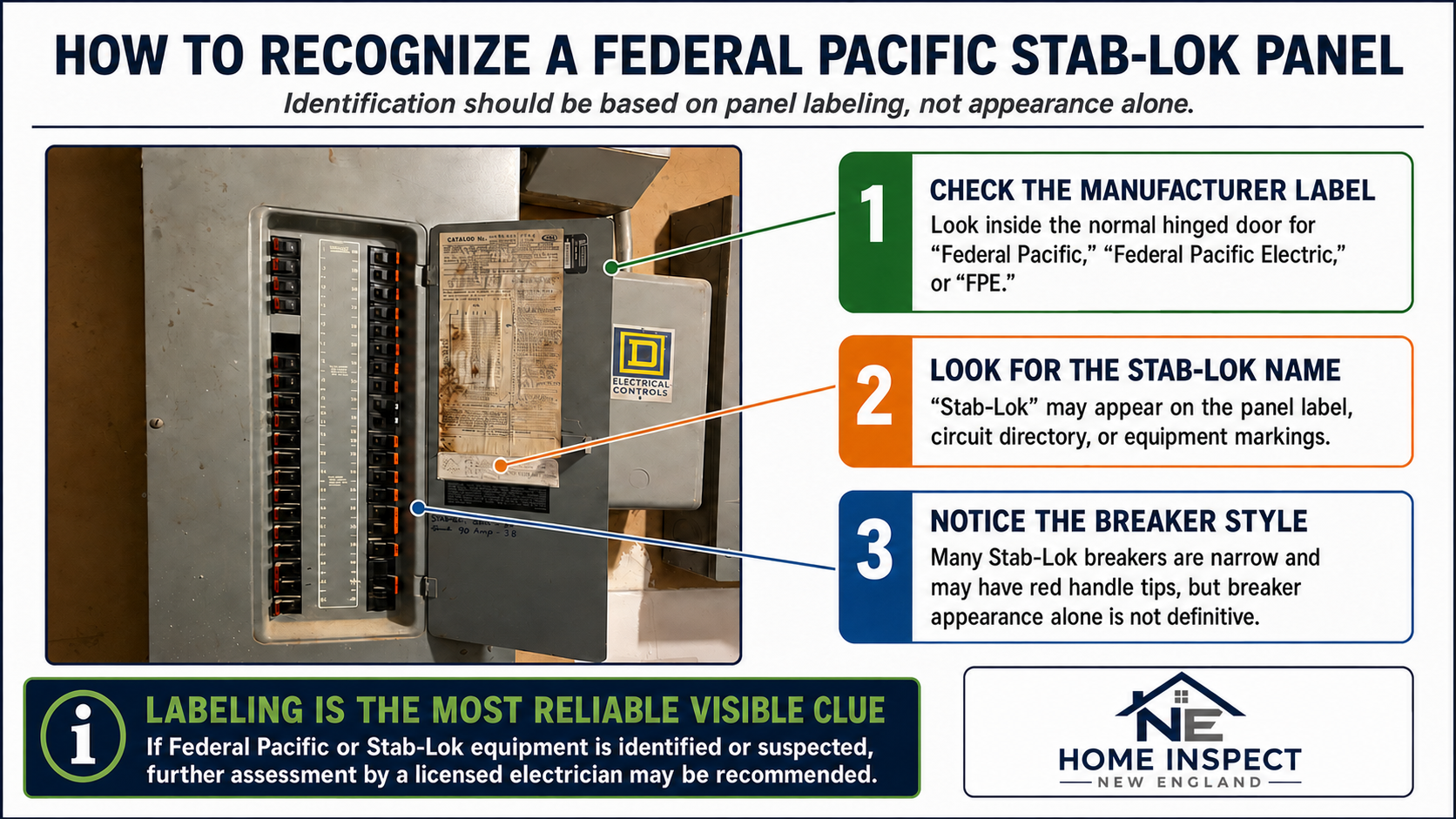
The panel may be labeled:
- Federal Pacific Electric
- Federal Pacific
- FPE
- Stab-Lok
Branding is commonly located on the inside surface of the hinged panel door. It may also appear on manufacturer labels or accessible breaker faces. Labels may be faded, painted over, damaged, or missing, so positive identification is not always possible.
What Is a Circuit Breaker Supposed to Do?
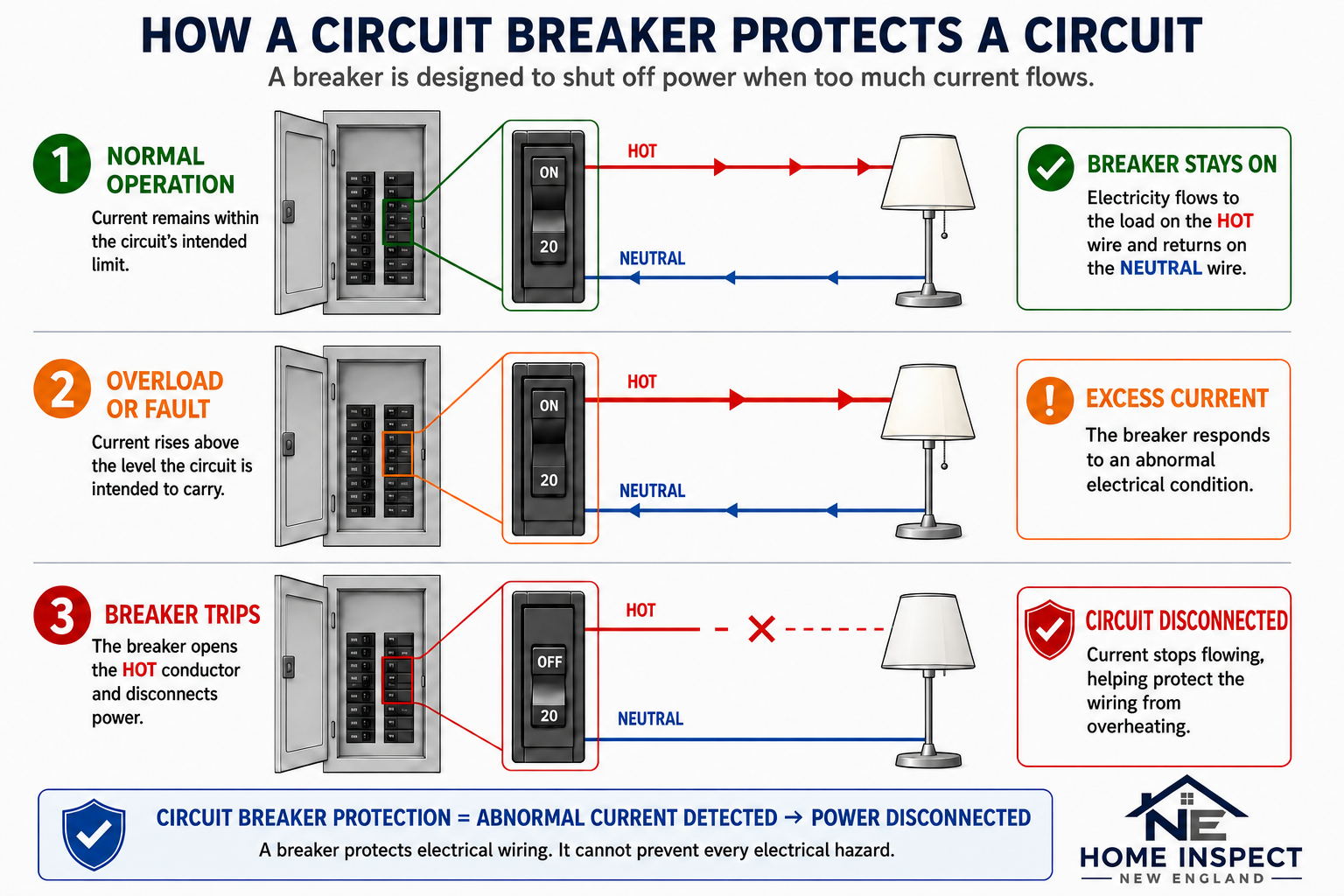
A circuit breaker is an automatic safety device. It is designed to shut off electrical current when a circuit carries more current than it is intended to handle or when certain fault conditions occur.
During normal use, a breaker may remain on for years without doing anything noticeable. Its most important job begins when an abnormal electrical condition develops.
If a breaker does not trip when it should, wiring can remain energized while excessive current continues to flow. That can allow electrical conductors and connections to overheat.
Why Are Federal Pacific Stab-Lok Breakers a Concern?
The concern is not simply that the panel is old. It involves the protective performance of certain breakers.
In 1980, the parent company of Federal Pacific Electric reported to the U.S. Consumer Product Safety Commission that many FPE breakers did not fully comply with Underwriters Laboratories requirements. CPSC testing later confirmed that certain breakers failed some UL calibration tests.
Calibration testing evaluates whether a breaker carries its rated current and opens within required time limits when current rises above its rating.
This history has led many home inspectors, electricians, and insurance companies to treat Federal Pacific Stab-Lok panels as a significant concern that warrants professional evaluation.
Does a Panel That Appears to Work Normally Mean It Is Safe?
Not necessarily.
Lights, receptacles, and appliances can operate normally even if a breaker has a problem with its protective function. Everyday electrical use does not confirm that every breaker will trip correctly during an overload or fault.
Likewise, turning a breaker handle on and off does not provide the same information as specialized performance testing. A standard home inspection does not test breakers by creating overloads or fault conditions.
Was There a Federal Recall?
No broad CPSC recall of Federal Pacific Stab-Lok panels was issued.
The CPSC closed its two-year investigation in 1983. The agency stated that the information available at that time did not establish that the breakers presented a serious risk of injury to consumers. It also stated that it did not have enough information to accept or reject the manufacturer's position regarding the failed calibration tests.
The CPSC later emphasized that closing the investigation was not a determination about the safety of FPE breakers.
This distinction matters. It would be inaccurate to say the CPSC declared all Federal Pacific panels unsafe. It would also be inaccurate to say the investigation proved there was no concern.
Can a Home Inspector Determine Whether the Breakers Will Trip Properly?
No.
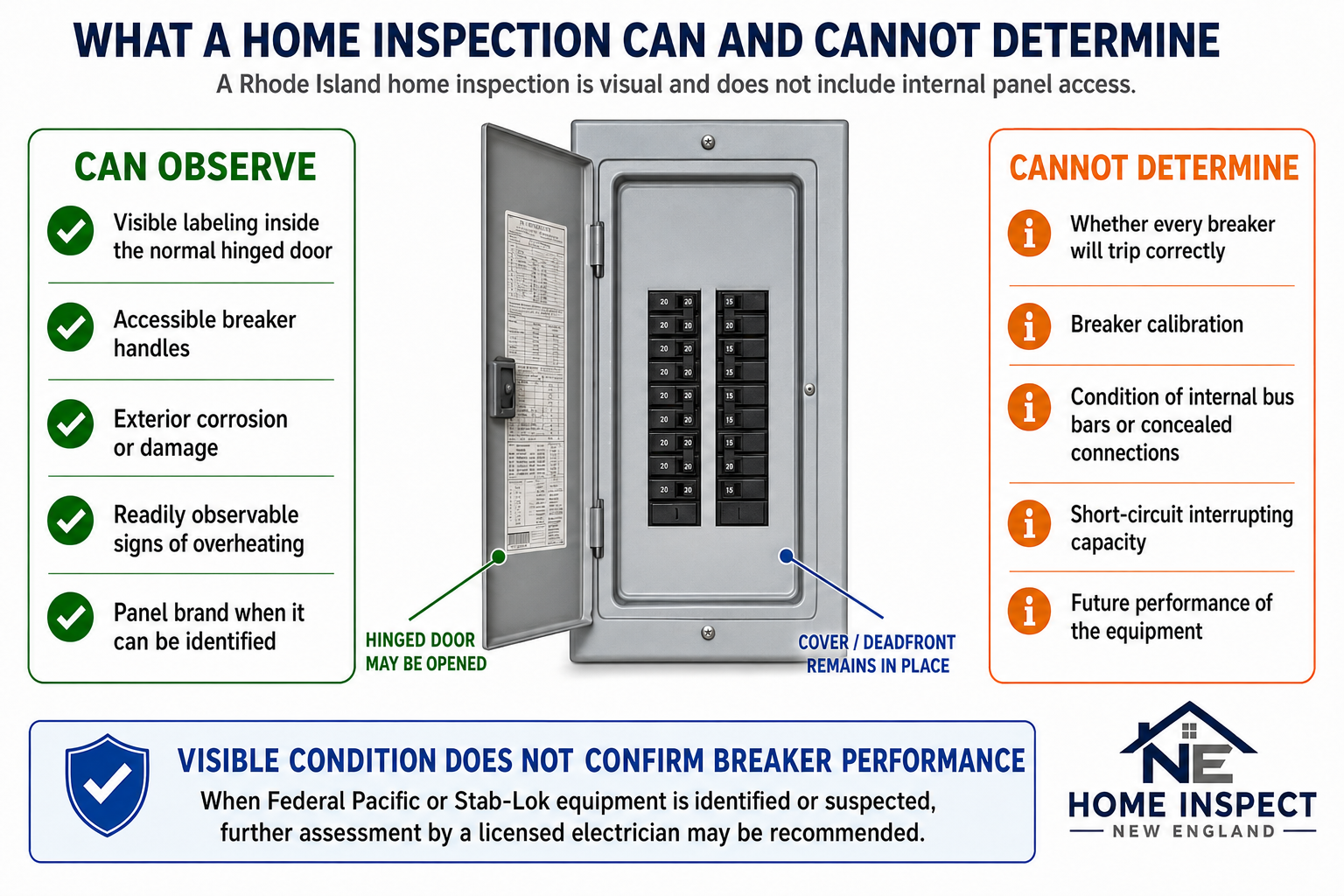
A Rhode Island home inspector may open the normal hinged panel door to observe readily visible labeling, breaker handles, and accessible exterior components. Visible concerns such as corrosion, damage, or signs of overheating may be reported when they are readily observable.
Home inspectors do not remove the panel cover or deadfront, enter the panel enclosure, operate circuit breakers, create overloads, test breaker calibration, or verify the internal operation of individual breakers.
The absence of visible overheating or damage does not confirm that the panel's protective devices will perform as intended.
Does a Federal Pacific Panel Need to Be Replaced?
Replacement is commonly recommended, but the appropriate next step should be determined by a licensed electrician who has evaluated the installation.
The electrician may consider:
- Whether the panel is an FPE Stab-Lok design
- The condition of the panel, breakers, and bus bars
- Signs of overheating, corrosion, or damage
- Whether breakers and conductors are properly sized
- The panel's service capacity and available space
- Past modifications or incompatible components
- Current and planned electrical demand
- Local permit and utility requirements
Replacing only an individual breaker may not address concerns involving the rest of the panel or its internal connections. A panel replacement may also reveal related work involving the service entrance, grounding, bonding, meter equipment, or branch-circuit wiring.
An electrician should explain the recommended scope of work and provide a written estimate.
Could a Federal Pacific Panel Affect Home Insurance?
Possibly.
Insurance requirements vary by company and can change. Some insurers may request an electrical evaluation, require replacement, limit available coverage, or decline to insure a home with a Federal Pacific Stab-Lok panel. Other insurers may use different underwriting requirements.
Contact your insurance company early in the buying process. Provide accurate information and, when possible, photographs of the panel label and breakers. Ask whether replacement is required before coverage can begin and obtain the answer in writing.
Waiting until shortly before closing can create problems if the insurer requires work that has not been scheduled or completed.
What Should I Do Before Buying the House?
If a Federal Pacific or Stab-Lok panel is present or suspected:
- Have a licensed electrician evaluate the panel and electrical service.
- Ask whether replacement is recommended.
- Request a written estimate for the complete scope of work.
- Contact your insurance company before important purchase deadlines.
- Ask the seller for permits, invoices, or documentation of previous electrical work.
- Consider the cost and timing of repairs when evaluating the property.
Do not remove the panel cover or attempt to inspect internal components yourself. Electrical panels can contain energized parts even when the main disconnect is turned off.
Should the Panel Stop Me From Buying the House?
Not automatically.
A Federal Pacific panel is a condition to understand and plan for, not a complete description of the house. The decision should consider the electrician's findings, the cost of recommended work, insurance requirements, and the condition of the home's other major systems.
For some buyers, a documented replacement cost can become part of repair planning or purchase negotiations. The goal is to make the decision with realistic information rather than ignoring the panel or assuming the worst.
Rhode Island Home Inspection Note
A Rhode Island home inspection includes visual observation of readily accessible electrical service equipment and panel exteriors. Home inspectors do not enter or internally access electrical panels.
The inspection does not include operating circuit breakers, creating overloads, testing breaker calibration, or determining the short-circuit interrupting capacity of the equipment. When visible labeling or other readily accessible information identifies or suggests a Federal Pacific or Stab-Lok panel, further assessment by a licensed electrician may be recommended.
The Bottom Line
Federal Pacific Stab-Lok panels are a concern because certain breakers failed UL calibration testing and may not provide the protective performance expected from a circuit breaker.
The CPSC did not issue a broad recall or make a final determination that every FPE breaker was unsafe. However, a panel that appears to operate normally cannot demonstrate how its breakers will respond during an overload or fault.
If one of these panels is present, obtain an evaluation and written estimate from a licensed electrician, and contact the insurance company early. That information will help you decide how the panel affects the purchase and your plans for the home.
Home Inspect New England provides visual, non-invasive home inspections consistent with applicable Rhode Island requirements and the inspection agreement. A home inspection is not a code-compliance inspection and does not certify the future performance of electrical equipment.
Continue Learning
Interested in learning more about your home's electrical system? Explore these related articles:
- What Is a Double-Tapped Breaker?
- What Is an Open Ground?
- What Is AFCI Protection?
- What Is GFCI Protection?
- Should I Buy a House With Knob-and-Tube Wiring?
- What Does a Home Inspector Look For?
A home inspection is one of the best opportunities to understand a home before you buy it. Home Inspect New England provides thorough, objective home inspections with clear communication and practical recommendations designed to help you make informed decisions with confidence.
Know Your Home Before You Buy.