
A double-tapped breaker is a circuit breaker with two electrical conductors connected to a single terminal.
Most residential circuit breakers are designed to secure one conductor beneath the terminal screw. When two conductors are installed at a terminal designed for only one, the connection may not hold both wires securely.
However, not every breaker with two connected wires is improperly installed. Some breaker models are specifically designed and listed to accept two conductors. The breaker markings and manufacturer instructions determine whether the connection is acceptable.
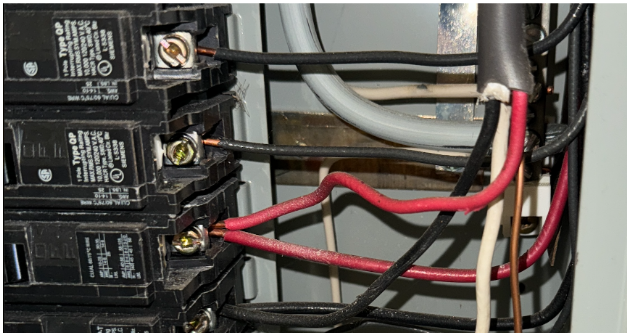
Why Can a Double-Tapped Breaker Be a Concern?
A breaker terminal must maintain firm, even contact with the conductor. If two wires are installed beneath a terminal that was designed for one, one conductor may not be clamped as securely as the other.
A loose electrical connection can create resistance and heat. Over time, this may contribute to:
- Overheating at the breaker terminal
- Damage to the conductor insulation
- Arcing
- Intermittent power to the circuit
- Damage to the breaker or electrical panel
- Increased risk of an electrical fire
The connection may look secure from the outside but still be uneven beneath the terminal. Conductors of different sizes or materials can make it more difficult for a terminal to hold both wires properly.
Are Two Wires on One Breaker Always Wrong?
No. Certain circuit breakers are listed for use with two conductors.
A breaker designed for two wires typically has a terminal shaped to secure both conductors independently or markings that identify the permitted conductor sizes and types. The exact requirements vary by manufacturer and breaker model.
The connection must follow the manufacturer's specifications, including:
- The number of conductors permitted
- The allowable conductor sizes
- Whether copper, aluminum, or both are permitted
- The required tightening torque
- The specific panel in which the breaker is approved for use
The presence of two wires alone does not determine whether the installation is acceptable. The breaker must be identified for that use, and the conductors must meet its listed specifications.
Why Would Someone Connect Two Wires to One Breaker?
A double tap is often created when an additional circuit is added but there is no convenient open breaker space in the panel. Instead of installing an appropriate new breaker or modifying the circuit correctly, someone may place the new conductor beneath an existing breaker terminal.
It may also result from:
- A previous renovation or addition
- An added light, receptacle, or appliance
- An improperly completed electrical repair
- Limited space in the electrical panel
- Confusion about whether the breaker accepts two conductors
Finding a double tap does not reveal when it was installed or who installed it. Further evaluation may be needed to determine what each conductor supplies and whether the connection is permitted.
Is a Double-Tapped Breaker the Same as a Tandem Breaker?
No. These terms describe different conditions.
A double-tapped breaker has two conductors connected to one breaker terminal.
A tandem breaker contains two separate breaker mechanisms within the space normally occupied by one full-size breaker. Each circuit has its own terminal and operating handle.
Tandem breakers are acceptable only when they are listed for use in that specific panel and installed in a location where the panel manufacturer permits them. A tandem breaker does not have the same connection concern as placing two wires beneath a terminal designed for one.
How Is an Improper Double Tap Corrected?
The appropriate correction depends on the panel, the breaker, the connected circuits, and the available capacity.
Common approaches may include:
- Joining the two circuit conductors to one properly sized pigtail, with the single pigtail connected to the breaker
- Installing an additional breaker when the panel is designed to accept one
- Installing a properly listed breaker that is designed for two conductors
- Reconfiguring the circuits or panel when additional work is needed
A pigtail does not create additional electrical capacity. The connected loads must still be appropriate for the circuit and breaker. Adding a breaker also requires more than finding an empty space — the panel's design, labeling, condition, and electrical capacity must be considered.
A licensed electrician should determine the appropriate correction. Electrical panel work can expose a person to energized components, even when the main disconnect is turned off.
Does a Double Tap Mean the Electrical Panel Must Be Replaced?
Usually, no. An isolated double-tapped breaker can often be corrected without replacing the entire panel.
Panel replacement may be considered when there are broader concerns, such as significant damage, overcrowding, incompatible components, obsolete equipment, or insufficient capacity. The presence of one double tap does not establish that the entire panel needs replacement.
What Should a Home Buyer Know?
A double-tapped breaker is a relatively common home inspection finding. It should be evaluated in context rather than treated as evidence of a major electrical failure.
The important questions are:
- Is the breaker designed and listed for two conductors?
- Are both conductors permitted by the breaker manufacturer?
- Is the connection secure and free from visible overheating or damage?
- What do the connected conductors supply?
- Is additional electrical work needed to correct the condition safely?
When the breaker is not identified for two conductors, or its suitability cannot be confirmed, evaluation and correction by a licensed electrician may be recommended.
What Does a Rhode Island Home Inspection Include?
A Rhode Island home inspection is visual and non-invasive. Readily accessible electrical components and visible conditions are observed and reported within the scope of the inspection.
Home Inspect New England does not open electrical panels. Concealed connections, terminal tightness, conductor torque, circuit loading, and the full compatibility of installed components cannot be determined during a visual home inspection.
When an apparent double tap or another electrical concern is visible, further evaluation by a licensed electrician may be recommended.
The Bottom Line
A double-tapped breaker has two conductors connected to one breaker terminal. This can create an unreliable connection when the breaker is designed for only one conductor.
Some breakers are specifically listed to accept two conductors, so the condition should not be judged by appearance alone. The breaker markings, manufacturer instructions, conductor sizes, and installation details determine whether the connection is acceptable.
When the connection is not permitted or cannot be confirmed, a licensed electrician can evaluate the circuit and determine the appropriate correction.
Home Inspect New England provides visual, non-invasive home inspections consistent with applicable Rhode Island requirements and the inspection agreement. A home inspection is not a code-compliance inspection and does not guarantee that every electrical concern will be identified.
Continue Learning
Interested in learning more about your home's electrical system? Explore these related articles:
- What Is AFCI Protection?
- What Is GFCI Protection?
- What Is an Open Ground?
- What Does a Home Inspector Look For?
A home inspection is one of the best opportunities to understand a home before you buy it. Home Inspect New England provides thorough, objective home inspections with clear communication and practical recommendations designed to help you make informed decisions with confidence.
Know Your Home Before You Buy.